
Creating a digital product suitable for Corporate Finance Analysts requires a focus on advanced data analysis, real-time financial reporting, and seamless integration with existing corporate finance systems. The solution must offer intuitive dashboards, predictive analytics, and customizable financial modeling tools to enhance decision-making processes. Security and compliance with financial regulations are critical to protect sensitive corporate data. Explore the article for detailed ideas on designing an effective digital product tailored to the finance sector.
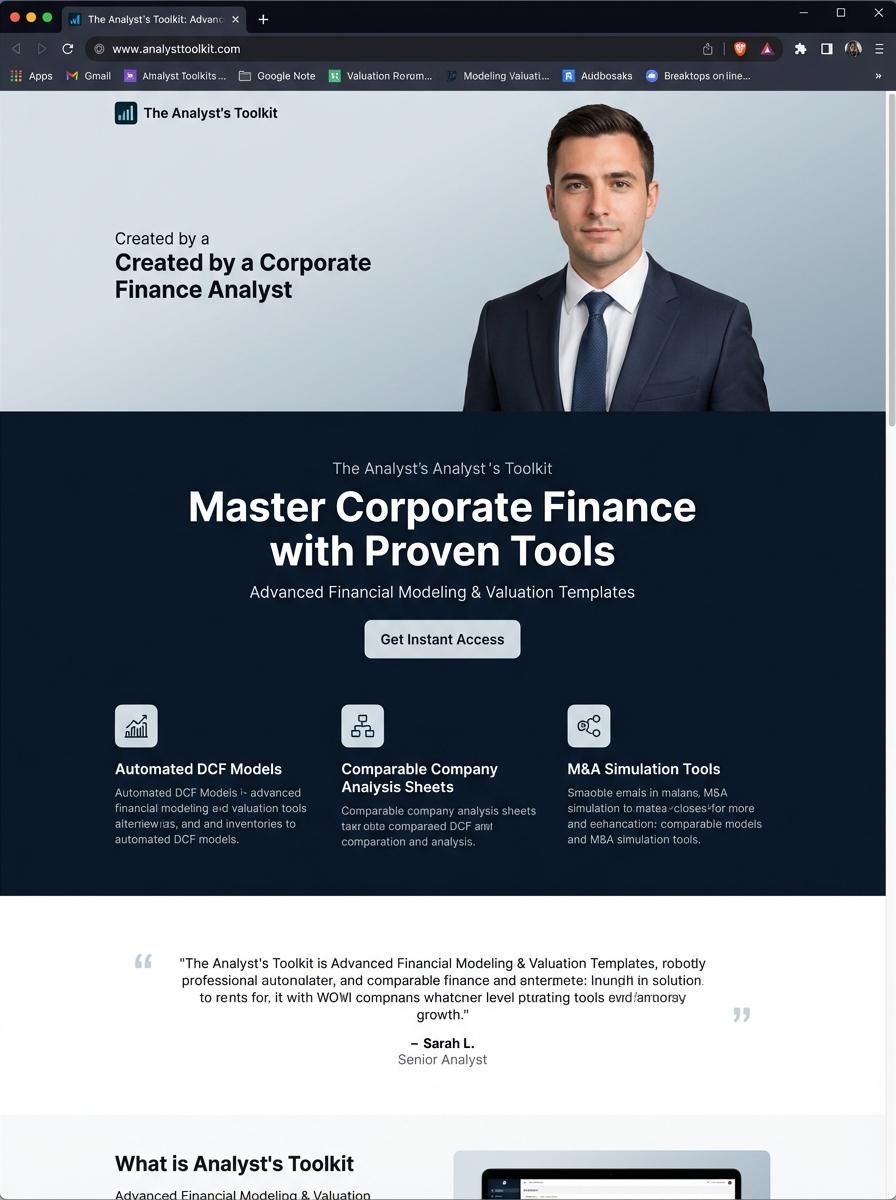
Illustration: Landing page for digital product for Corporate finance analyst
Financial Modeling Templates (Excel)
Financial Modeling Templates in Excel streamline complex budgeting, forecasting, and valuation tasks for corporate finance analysts. These templates incorporate dynamic formulas, scenario analysis tools, and balance sheet linkages to ensure accuracy and efficiency. Customization options support various industry standards and reporting requirements.
- Skill Needed: Advanced proficiency in Microsoft Excel, including pivot tables, macros, and VBA scripting.
- Product Requirement: Pre-built templates must include modular sheets for income statements, cash flow projections, and debt schedules.
- Specification: Templates should support real-time data updates and multi-scenario comparisons for strategic decision-making.
Corporate Valuation Reports (PDF)
A Corporate Valuation Report provides a detailed analysis of a company's worth, utilizing financial metrics such as EBITDA, discounted cash flows, and market comparables. It supports corporate finance analysts in making informed decisions on mergers, acquisitions, and investment strategies. Precision in financial modeling and clarity in data presentation are critical for these reports.
- Skill needed: Proficiency in financial analysis, valuation methods, and data visualization techniques.
- Product requirement: Ability to generate and export comprehensive PDF reports that include charts, graphs, and detailed financial breakdowns.
- Specification: Incorporate customizable templates for various valuation approaches and ensure reports are compliant with accounting standards and corporate governance.
Budgeting & Forecasting Tools (Excel)
Corporate finance analysts rely on Budgeting & Forecasting Tools in Excel to create dynamic financial models, analyze trends, and predict future corporate performance. These tools integrate historical financial data with advanced formulas and pivot tables to generate accurate and actionable insights. Leveraging Excel's flexibility enables analysts to customize forecasts aligned with strategic business goals.
- Skills needed: Advanced Excel proficiency, financial modeling, data analysis, and knowledge of corporate finance principles.
- Product requirements: Customizable templates, integration with real-time financial data, and support for scenario analysis and sensitivity testing.
- Specifications: Must include dynamic dashboards, automated calculations, and compatibility with common corporate ERP systems for seamless data import/export.
M&A Analysis Checklists (PDF)
Creating a digital product like M&A Analysis Checklists (PDF) requires thorough understanding of corporate finance principles and merger and acquisition processes. These checklists must cover critical due diligence areas such as financial statements, valuation analyses, and risk assessments. Precise and structured documentation enhances decision-making efficiency for Corporate Finance Analysts.
- Skill needed: Expertise in financial modeling, valuation techniques, and regulatory compliance in M&A transactions.
- Product requirement: Ensure the checklist includes comprehensive due diligence categories and customizable sections for different deal types.
- Specification: PDF format must support interactive elements like checkboxes and hyperlinks for easy navigation and usability.
Industry Benchmarking Dashboards (Excel)
Corporate finance analysts rely on Industry Benchmarking Dashboards created in Excel to systematically compare financial performance across competitors. These dashboards consolidate key financial metrics such as revenue growth, profit margins, and liquidity ratios into a single, interactive interface. They enable data-driven decision-making by visualizing trends and anomalies relevant to industry standards.
- Skill needed: Advanced Excel proficiency including pivot tables, VLOOKUP, and data visualization techniques.
- Product requirement: Integration of real-time financial data feeds to ensure up-to-date benchmarking metrics.
- Specification: Dashboard must include customizable KPIs, conditional formatting, and exportable summary reports.
Cash Flow Analysis Tutorials (Video)
Corporate finance analysts require a deep understanding of cash flow analysis to enhance decision-making and optimize financial strategies. Video tutorials provide a practical approach to mastering cash flow statements, forecasting, and liquidity management. These tutorials offer real-world scenarios to improve analytical skills and interpret financial data effectively.
- Strong financial modeling and analytical skills
- High-quality video production with clear visuals and step-by-step explanations
- Content tailored to corporate finance, including case studies and relevant software demonstrations
Debt Covenant Compliance Trackers (Excel)
Debt Covenant Compliance Trackers in Excel are essential tools for corporate finance analysts to monitor and ensure adherence to loan agreements. These trackers automate the calculation of financial ratios and flag any breaches, facilitating timely decision-making. They support the management of complex debt structures by integrating real-time financial data for accurate compliance tracking.
- Skills needed: Advanced Excel functions, financial ratio analysis, and knowledge of debt covenants.
- Product requirements: Automated calculation of key financial covenants, dynamic data input, and real-time alerts for breaches.
- Specifications: User-friendly interface, customizable templates for different loan agreements, and secure data handling.
Data-Driven Insights for Strategic Decision-Making
Utilizing data-driven insights is essential for making informed marketing decisions. These insights help identify customer preferences, optimize campaigns, and allocate resources effectively. Embracing data allows marketers to adapt strategies swiftly and improve overall product performance. Leveraging these insights ensures a competitive edge in a fast-evolving digital market.
Real-Time Financial Performance Dashboards
Real-time dashboards provide immediate visibility into the financial performance of your digital product. Marketers can track revenue, expenses, and ROI to make quick adjustments and boost profitability. Continuous monitoring helps in spotting trends and identifying growth opportunities. This transparency supports agile decision-making aligned with market demands.
Seamless Integration with Existing ERP Systems
Integrating marketing tools with existing ERP systems streamlines workflows and data management. It ensures consistent information flow across departments, enhancing operational efficiency. Seamless integration enables better inventory control, customer management, and financial reporting. This interoperability supports cohesive business strategies and improves overall productivity.
Advanced Predictive Analytics for Risk Management
Advanced predictive analytics helps anticipate potential risks and market shifts before they occur. By analyzing historical data and trends, marketers can identify vulnerabilities and plan mitigation strategies. This foresight reduces uncertainty and supports sustainable growth. Incorporating analytics enhances the ability to respond proactively to challenges.
Enhanced Compliance and Reporting Automation
Automating compliance and reporting simplifies adherence to regulations and reduces errors. Automated systems ensure timely submissions and accurate documentation, minimizing legal risks. This efficiency frees up resources to focus on strategic marketing initiatives. Compliance automation also builds trust with stakeholders and customers alike.