
Creating a digital product tailored for a Voice over IP engineer in the telecommunications sector requires a deep understanding of network protocols and VoIP technologies. The product should enhance call quality, streamline system management, and offer robust security features to prevent unauthorized access. Integration with existing telecom infrastructure and scalability are crucial for addressing evolving industry needs. Explore the article for detailed ideas on developing an effective solution in this specialized field.
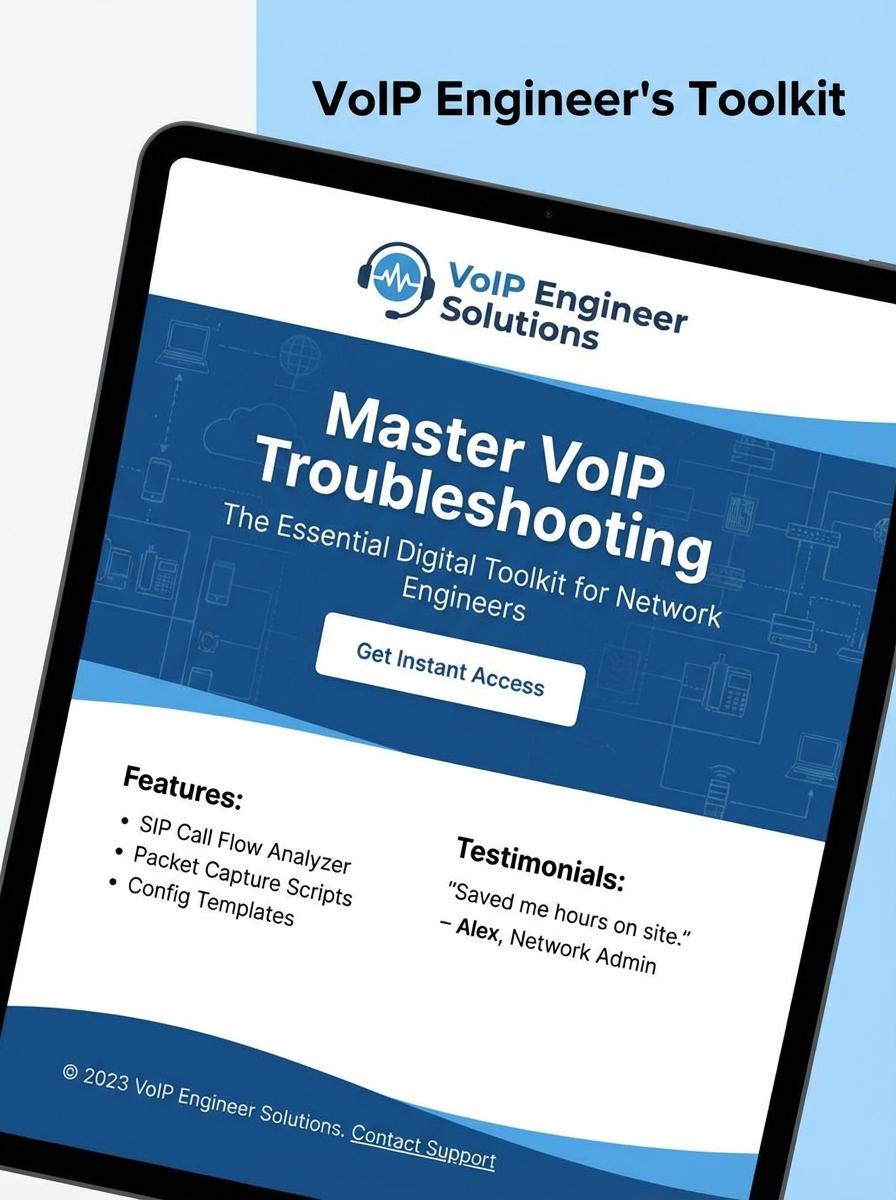
Illustration: Landing page for digital product for Voice over IP engineer
VoIP Network Architecture Design Templates (PDF/Visio)
VoIP Network Architecture Design Templates provide structured frameworks tailored for Voice over IP engineers to streamline the planning and deployment of VoIP systems. These templates, available in PDF and Visio formats, illustrate essential network components such as routers, gateways, and session border controllers with clear topology and signaling flow. They ensure consistency and accuracy in designing scalable, secure, and high-performance VoIP infrastructures.
- Skill Needed: Proficiency in VoIP protocols (SIP, RTP), network topology, and diagramming tools like Microsoft Visio.
- Product Requirement: Templates must support editable Visio files for customization and printable PDF versions for documentation.
- Specification: Include standardized network symbols, layered architecture views, and annotations highlighting QoS and security elements.
SIP Trunk Configuration Guide (PDF/Doc)
SIP Trunk Configuration involves setting up the connection between a private branch exchange (PBX) and the internet to enable Voice over IP (VoIP) communication. Proper configuration ensures seamless call routing, optimized bandwidth usage, and compatibility with Session Initiation Protocol (SIP) standards. Engineers must account for network security, codec selection, and failover mechanisms to maintain call quality and reliability.
- Proficient in SIP protocol operation and troubleshooting.
- Support for major PBX systems (e.g., Asterisk, Cisco, Avaya) compatibility.
- Detail on network requirements including firewall, NAT traversal, and QoS settings.
VoIP Security Best Practices Checklist (PDF/Excel)
Voice over IP (VoIP) engineers must implement VoIP security best practices to protect communication systems from vulnerabilities such as SIP fraud, toll fraud, and denial of service attacks. Emphasis should be placed on securing signaling protocols and encrypting voice traffic to maintain confidentiality and integrity. Continuous monitoring and regular updates are essential to adapting to evolving threats in VoIP environments.
- Skill needed: Expertise in SIP, RTP protocols, encryption standards like SRTP, and network security principles.
- Product requirement: The checklist must include clear guidelines for secure configuration, vulnerability assessment, and incident response procedures.
- Specification: Format available in both PDF and Excel to facilitate easy documentation, tracking, and compliance verification by VoIP engineers.
Interactive VoIP Troubleshooting Flowcharts (PDF/Excel)
Creating Interactive VoIP Troubleshooting Flowcharts in PDF or Excel formats streamlines the diagnostic process for Voice over IP engineers by visually mapping problem-solving steps. These flowcharts enhance clarity and efficiency during call quality assessments, network latency checks, and device configuration verifications. Incorporating dynamic links and conditional logic supports rapid decision-making in real-time VoIP issue resolution.
- Skill needed: Expertise in VoIP protocols such as SIP, RTP, and understanding of network diagnostics.
- Product requirement: Compatibility with PDF and Excel software, including interactive elements like hyperlinks and dropdown menus.
- Specification: Must include clear branching logic for common VoIP issues such as jitter, packet loss, and codec mismatches.
VoIP Quality of Service (QoS) Optimization Guide (PDF)
VoIP Quality of Service (QoS) optimization is essential to ensure clear and reliable voice communication over IP networks. Engineers must focus on minimizing latency, jitter, and packet loss to maintain high call quality. This guide provides practical strategies for configuring network devices and prioritizing voice traffic effectively.
- Skills Needed: Network traffic analysis, VoIP protocol expertise (SIP, RTP), and QoS configuration.
- Product Requirements: Compatibility with SIP and RTP protocols, support for DiffServ or MPLS QoS mechanisms.
- Specifications: Guidelines for latency under 150ms, jitter less than 30ms, and packet loss below 1% for optimal voice clarity.
IP PBX Setup Tutorial Videos (Video)
IP PBX setup involves configuring a private branch exchange system to manage voice communication over Internet Protocol networks. Voice over IP engineers must understand SIP protocols, network configuration, and call routing to optimize system performance. These tutorial videos guide through practical setup processes and common troubleshooting techniques.
- Skill Needed: Proficiency in SIP trunking, network protocols, and VoIP system integration.
- Product Requirement: Clear, step-by-step video demonstrations covering hardware installation and software configuration.
- Specification: Support for various IP PBX platforms, including Asterisk, FreePBX, and 3CX, with detailed troubleshooting sections.
Call Detail Record (CDR) Analysis Tools (Excel)
Call Detail Record (CDR) Analysis Tools in Excel empower Voice over IP engineers to efficiently parse, filter, and analyze telephony data. These tools facilitate rapid identification of call patterns, billing discrepancies, and network issues by leveraging Excel's data processing capabilities. The ability to visualize call metrics enhances network performance optimization and troubleshooting accuracy.
- Skill needed: Proficiency in Excel functions, data filtering, and pivot tables to manipulate large datasets.
- Product requirement: Import and parse CDR data from multiple VoIP platforms reliably and quickly.
- Specification: Provide built-in charts and dashboards for visual call pattern analysis and anomaly detection.
Seamless VoIP Integration for Enterprise Scalability
Ensuring seamless VoIP integration is crucial for marketing a digital product targeting enterprises. This approach supports scalability, allowing businesses to grow without communication disruptions. Highlighting how your product easily integrates with existing systems attracts large-scale clients. Simplifying the integration process can significantly enhance customer satisfaction and retention.
Enhanced Call Quality with Low-Latency Connections
Marketing should emphasize enhanced call quality to appeal to users prioritizing clear communication. Low-latency connections reduce delays and improve user experience, a key selling point. Demonstrating superior call performance differentiates your product from competitors. Providing reliable, high-quality calls can increase conversion rates and customer loyalty.
Robust Security and End-to-End Encryption for VoIP
Robust security and end-to-end encryption are vital for building trust with customers concerned about data privacy. Marketing your product with a focus on secure VoIP connections reassures potential clients. Security features should be clearly communicated to emphasize protection against cyber threats. This strategy helps position your product as a trustworthy choice in the digital marketplace.
Easy API Access for Rapid Deployment and Management
Offering easy API access allows quick deployment and flexible management, key benefits for developers and businesses. Marketing messaging should focus on how this accelerates integration and customization processes. Streamlined API access is a competitive advantage for tech-savvy customers. Simplifying technical adoption enhances user onboarding and satisfaction.
Reliable Uptime with 24/7 Technical Support for Engineers
Reliable uptime backed by 24/7 technical support builds confidence in your digital product's dependability. Highlighting round-the-clock assistance appeals to enterprise customers needing continuous operation. Prompt support minimizes downtime and addresses issues efficiently. This assurance can be a decisive factor for businesses choosing your solution.