
Creating a digital product suitable for Quality Assurance testers in the technology sector requires a deep understanding of testing workflows and automation needs. The product must streamline bug tracking, support various testing environments, and integrate seamlessly with existing development tools. Emphasizing user-friendly interfaces and robust reporting features enhances tester efficiency and accuracy. Explore the article to discover detailed strategies and ideas for designing effective QA-focused digital solutions.
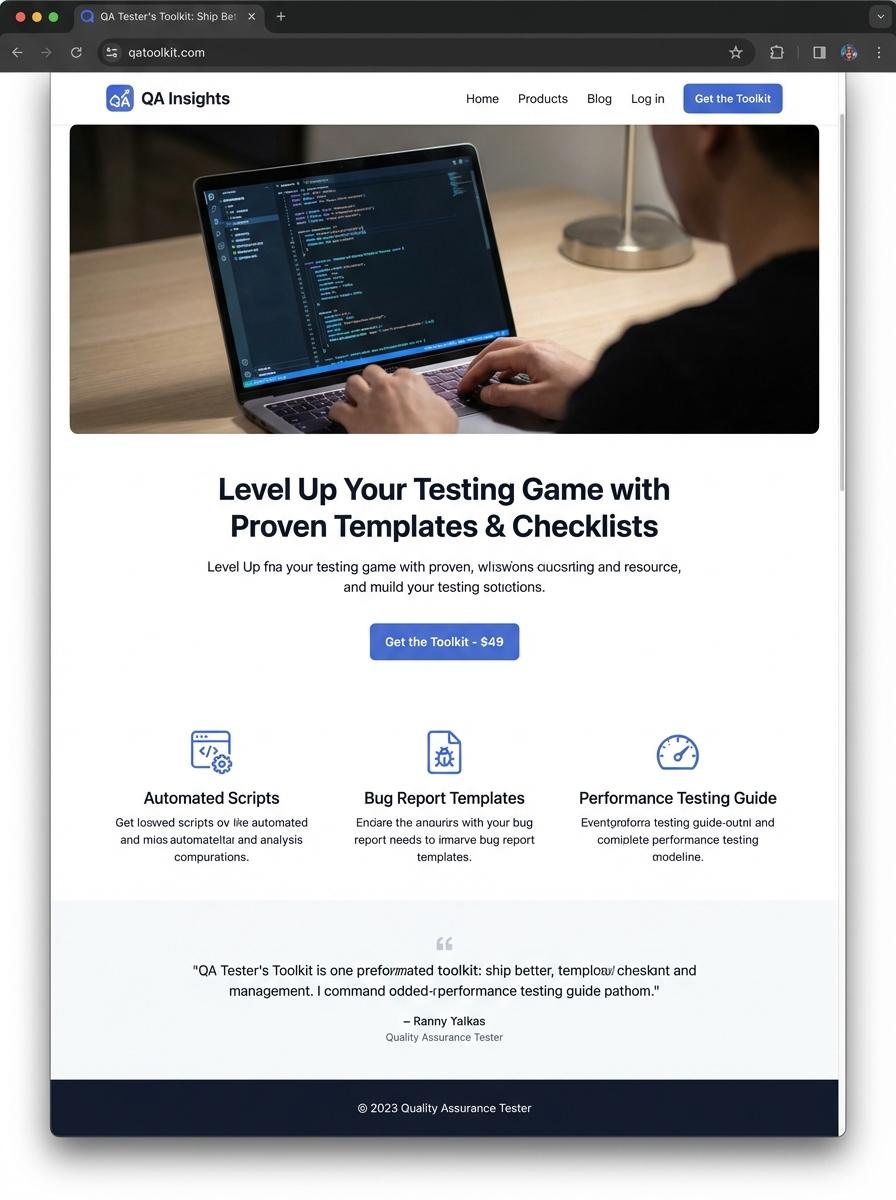
Illustration: Landing page for digital product for Quality assurance tester
Test Case Template (Excel/Doc)
A well-structured Test Case Template is crucial for Quality Assurance testers to systematically validate software functionality. It ensures comprehensive coverage of test scenarios, expected results, and execution status within an easily accessible Excel or Word document. Consistent use of templates enhances collaboration and traceability throughout the testing lifecycle.
- Skills needed: attention to detail, knowledge of software testing methodologies, familiarity with Excel or Word.
- Product requirement: clear sections for test case ID, description, preconditions, steps, expected outcome, and actual result.
- Specification: user-friendly layout, ability to filter and sort test cases, and compatibility with common office software.
Bug Report Template (Excel/Doc)
Quality assurance testers rely on a Bug Report Template to systematically log and track software defects. This template, available in Excel or Doc format, organizes critical information such as bug ID, description, severity, steps to reproduce, and status updates. A well-structured template enhances communication between testers and developers, streamlining the debugging process and ensuring efficient issue resolution.
- Skill needed: Attention to detail and clear technical communication.
- Product requirement: Must include fields for bug ID, description, severity level, environment, and reproduction steps.
- Specification: Compatible with Excel and Word, allowing easy data entry, sorting, and sharing among team members.
QA Process Checklist (PDF/Excel)
The QA Process Checklist serves as a comprehensive guide for quality assurance testers to systematically verify software functionality, identify defects, and ensure adherence to project requirements. It outlines key testing stages including test planning, test execution, and bug reporting, promoting consistency and thoroughness across the QA lifecycle. Utilizing formats like PDF or Excel enhances accessibility and facilitates real-time updates or collaboration.
- Skill needed: Proficiency in manual and automated testing techniques plus attention to detail.
- Product requirement: Checklist must cover functional, regression, performance, and usability testing phases.
- Specification: Exportable and printable checklist available in both PDF and Excel format with clear, organized sections.
Test Plan Sample (PDF/Doc)
A Test Plan Sample in PDF or DOC format serves as a critical blueprint for Quality Assurance testers, detailing the testing strategy, objectives, scope, resources, and schedule. It outlines test cases, criteria for entry and exit, and risk assessment to ensure comprehensive coverage and quality control. These documents facilitate communication between testers, developers, and stakeholders to align expectations and improve software reliability.
- Skill Needed: Proficiency in test case design, risk analysis, and familiarity with QA methodologies.
- Product Requirement: The test plan must clearly define scope, objectives, testing environment, and resource allocation.
- Specification: Support for exporting to PDF and DOC, with editable fields for easy customization and version control.
User Acceptance Testing (UAT) Guide (PDF)
User Acceptance Testing (UAT) ensures that a digital product meets business requirements and functions correctly from the end-user perspective. Quality assurance testers play a crucial role in designing and executing UAT scenarios based on real-world use cases. UAT Guide (PDF) serves as a detailed resource outlining best practices, test plans, and evaluation criteria.
- Skills needed: proficiency in test case design, communication with stakeholders, and defect tracking.
- Product requirement: comprehensive test scenarios reflecting end-user workflows and acceptance criteria.
- Specification: clear UAT documentation structure, step-by-step test instructions, and reporting templates included in the PDF.
Software Testing E-book (PDF)
The Software Testing E-book (PDF) provides comprehensive methodologies for Quality Assurance testers to enhance testing processes. It covers test case design, defect tracking, and automation strategies tailored for effective quality control. The e-book enables testers to systematically improve software reliability and performance.
- Skill Needed: Proficiency in manual and automated testing tools and techniques.
- Product Requirement: Clear layout optimized for PDF viewing on multiple devices.
- Specification: Inclusion of real-world examples and updated best testing practices.
QA Training Video Tutorial (MP4)
Quality assurance testers require comprehensive training materials to enhance their skills in software testing methodologies and defect identification. The QA Training Video Tutorial in MP4 format delivers step-by-step guidance on industry standards, bug tracking, and test case execution. This format ensures accessibility and practical learning for testers aiming to improve software reliability.
- Skill needed: Understanding of software testing life cycle, attention to detail, and familiarity with defect tracking tools.
- Product requirement: High-definition MP4 format supporting multiple device compatibility including desktops and mobile devices.
- Specification: Clear audio narration with visual demonstrations, segmented chapters covering various QA topics, and downloadable resources for practice.
Reliable Bug Detection for Seamless User Experience
Ensuring a seamless user experience starts with reliable bug detection. Identifying and fixing bugs early prevents negative user feedback and enhances product credibility. Prioritize tools that offer real-time monitoring and comprehensive coverage. This approach minimizes disruptions and maintains customer trust.
Automated Testing Solutions for Faster Release Cycles
Implementing automated testing solutions accelerates release cycles without compromising quality. Automated tests help catch regressions quickly and reduce manual effort. This efficiency supports frequent updates and responsiveness to market demands. Faster releases keep your digital product competitive and relevant.
Scalable QA Tools to Support Agile Development
Scalable QA tools are essential for supporting agile development workflows. They adapt to changing project sizes and complexities, ensuring consistent quality. Integration with agile methodologies enables continuous testing and faster feedback loops. This scalability enhances collaboration and product improvement.
Detailed Reporting for Informed Decision Making
Access to detailed reporting empowers teams to make data-driven decisions. Comprehensive insights into testing results and bug trends highlight areas needing attention. Reports facilitate prioritization and resource optimization. Informed decisions drive strategic improvements and successful product launches.
Easy Integration with Popular DevOps Platforms
Seamless integration with popular DevOps platforms streamlines workflows and enhances productivity. Compatibility with existing tools reduces setup time and improves collaboration across teams. Integrated systems support continuous integration and deployment pipelines. This synergy accelerates development and market readiness.