
Creating a digital product tailored for a QA engineer in the technology sector requires a focus on usability, accuracy, and automation capabilities. Such a product should streamline testing processes, facilitate defect tracking, and support continuous integration and deployment. Emphasizing seamless integration with existing tools and real-time reporting can enhance efficiency and decision-making. Explore the article for comprehensive insights on developing effective solutions for QA professionals.
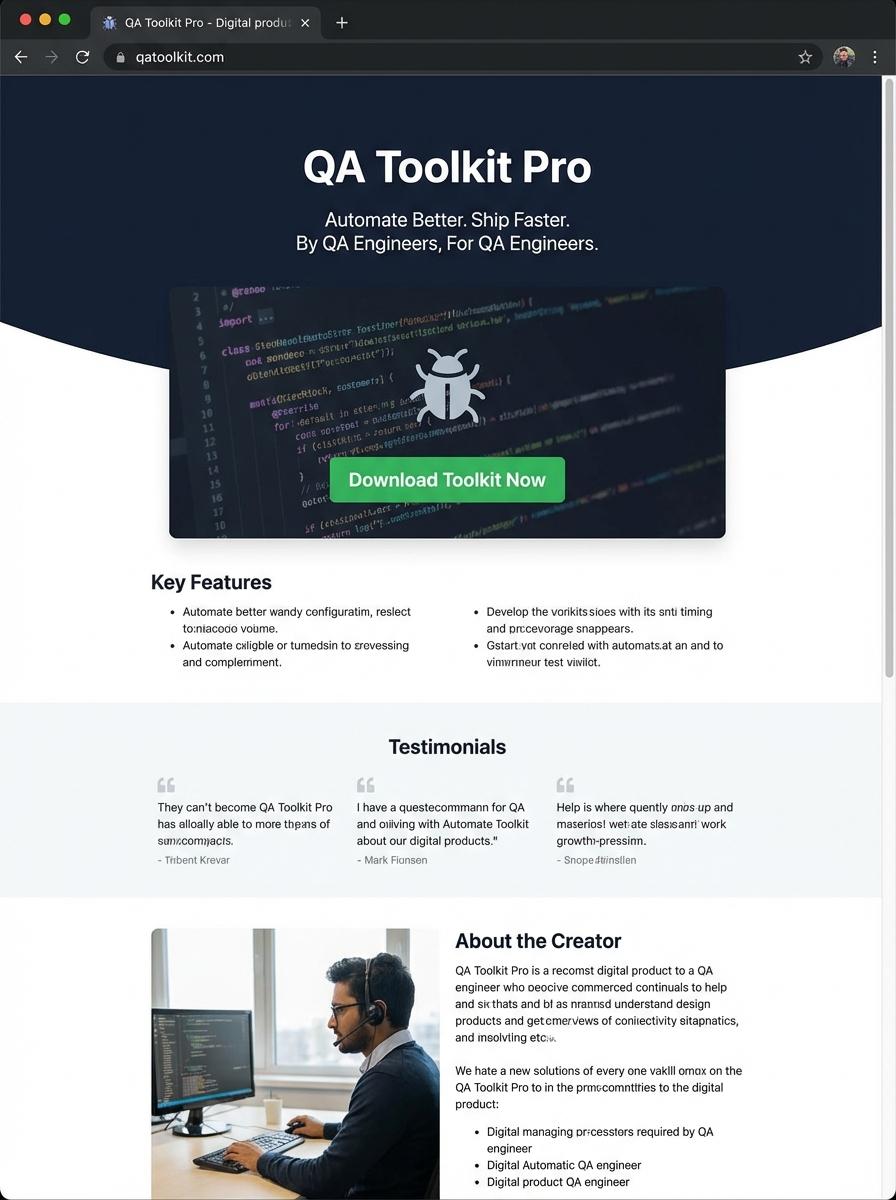
Illustration: Landing page for digital product for QA engineer
Test Case Template (Excel or Word document)
A Test Case Template in Excel or Word is essential for QA engineers to systematically document test cases and expected results for software testing. It facilitates clear communication, traceability, and consistency while executing test scenarios. Proper structuring of test case fields like ID, description, preconditions, steps, expected outcome, and actual result enhances test management efficiency.
- Skill needed: Proficiency in test case design principles and familiarity with QA methodologies.
- Product requirement: Template must include fields for test case ID, description, test steps, expected result, actual result, status, and comments.
- Specification: Must be compatible with Microsoft Excel or Word formats, allowing easy editing and version control.
Bug Report Template (Excel or Word document)
A Bug Report Template tailored for QA engineers streamlines the documentation process by organizing key details such as bug ID, description, severity, steps to reproduce, expected vs actual results, and screenshots. This template ensures consistency and clarity, facilitating efficient communication between QA teams and developers. Utilizing Excel or Word formats allows for easy customization and integration into existing workflows.
- Skills needed: Understanding of software testing processes, attention to detail, and basic proficiency in Excel or Word.
- Product requirements: Fields for bug identification, priority level, environment details, and reproducibility status.
- Specifications: Clear layout, editable sections, and compatibility with common office software.
QA Checklist (PDF or Excel)
A QA Checklist is an essential tool for QA engineers to systematically verify that all testing criteria are met. It ensures thorough coverage of functional, performance, and security tests according to project requirements. Using formats like PDF or Excel enhances accessibility and ease of use during the quality assurance process.
- Skills needed: Attention to detail, knowledge of testing methodologies, ability to document and organize test cases effectively.
- Product requirements: Clear categorization of test areas, customizable fields for various project types, compatibility with PDF and Excel formats.
- Specifications: User-friendly interface for checklist creation, export options to PDF/Excel, ability to track test status and results.
Automated Test Script Samples (ZIP with source code files)
Automated Test Script Samples provide QA engineers with ready-to-use, reusable source code files that enhance testing efficiency and accuracy. These scripts cover diverse test scenarios such as functional, regression, and performance testing, streamlining the quality assurance process. Access to a comprehensive collection of source code files accelerates script development and customization.
- Strong programming skills in languages like Java, Python, or JavaScript are needed for script customization and debugging.
- Product must include well-documented source code files organized in a ZIP archive for easy extraction and usage.
- Scripts should support integration with popular test automation frameworks such as Selenium, Appium, or Cypress.
Test Plan Document (PDF or Word document)
A comprehensive Test Plan Document outlines the testing strategy, scope, resources, and schedule for a software project. It serves as a blueprint for QA engineers to ensure systematic test coverage and traceability. Key elements include objectives, test scope, test environment, and risk assessment.
- Skills needed: Proficiency in test planning, risk analysis, and knowledge of software development lifecycles (SDLC).
- Product requirements: Clear definition of test objectives, criteria for pass/fail, and roles and responsibilities.
- Specifications: Format compatibility (PDF or Word), version control, and inclusion of detailed test scenarios and timelines.
QA Best Practices Guide (PDF)
The QA Best Practices Guide is a comprehensive resource tailored for QA engineers, focusing on effective testing methodologies and quality assurance processes. It highlights critical techniques such as automated testing, bug tracking, and performance validation to enhance product reliability. Emphasizing industry standards and metrics ensures the guide aids in maintaining high-quality software delivery.
- Skill needed: Proficiency in test automation tools and methodologies
- Product requirement: Clear structure supporting easy navigation between chapters
- Specification: Inclusion of real-world case studies and templates for practical application
Video Tutorial on Automated Testing Tools (MP4)
Automated testing tools enhance the efficiency and accuracy of software quality assurance processes for QA engineers. Mastering tools like Selenium, JUnit, and TestComplete enables faster test execution and early defect detection. Comprehensive video tutorials in MP4 format provide step-by-step guidance tailored to real-world testing scenarios.
- Skill needed: Proficiency in scripting languages such as Java, Python, or JavaScript for writing automated test scripts.
- Product requirement: Clear, high-resolution MP4 video demonstrations covering setup, test case creation, and result analysis.
- Specification: Include downloadable sample code and exercises to practice automated testing in diverse environments.
Targeted Messaging for QA Engineers' Pain Points
Crafting targeted messaging that directly addresses the unique challenges QA engineers face is crucial. Identify common pain points such as time-consuming manual testing and error-prone processes. Tailoring your communication to show understanding builds trust and relevance. This focused approach increases engagement and appeal.
Demonstrate Automation and Efficiency Gains
Highlight the automation capabilities of your digital product to showcase significant efficiency improvements. Emphasize how automating repetitive tasks reduces human error and accelerates testing cycles. Providing clear metrics on time saved adds credibility. This resonates strongly with QA teams focused on productivity.
Showcase Real-World QA Case Studies
Sharing real-world case studies demonstrates proven success and practical benefits of your product. Use examples from credible QA projects that overcame common testing challenges. Detailed stories enhance trust by showing concrete results. This strategy convinces prospects through relatable and evidence-based storytelling.
Emphasize Easy Integration with Existing Tools
Stress the seamless integration capability of your product with popular QA tools and workflows. QA engineers prioritize platforms that fit smoothly into their current technology stack without disruption. Highlighting compatibility reduces adoption friction. This makes your offering more appealing and easier to implement.
Highlight Continuous Support and Product Updates
Promote your commitment to ongoing support and regular product updates to build long-term customer confidence. QA environments evolve rapidly, so continuous improvements are essential. Providing robust support ensures users maximize the product's value. This reassurance fosters loyalty and sustained success.