
Creating a digital product tailored for a Logistic Coordinator in the Transportation sector requires seamless integration of real-time tracking, route optimization, and resource management features. Such a product enhances operational efficiency by reducing delays and improving communication between drivers, warehouses, and clients. Emphasizing user-friendly interfaces and automation tools ensures coordinators can manage complex logistics smoothly. Explore our article for detailed strategies on designing the perfect digital solution for transportation logistics.
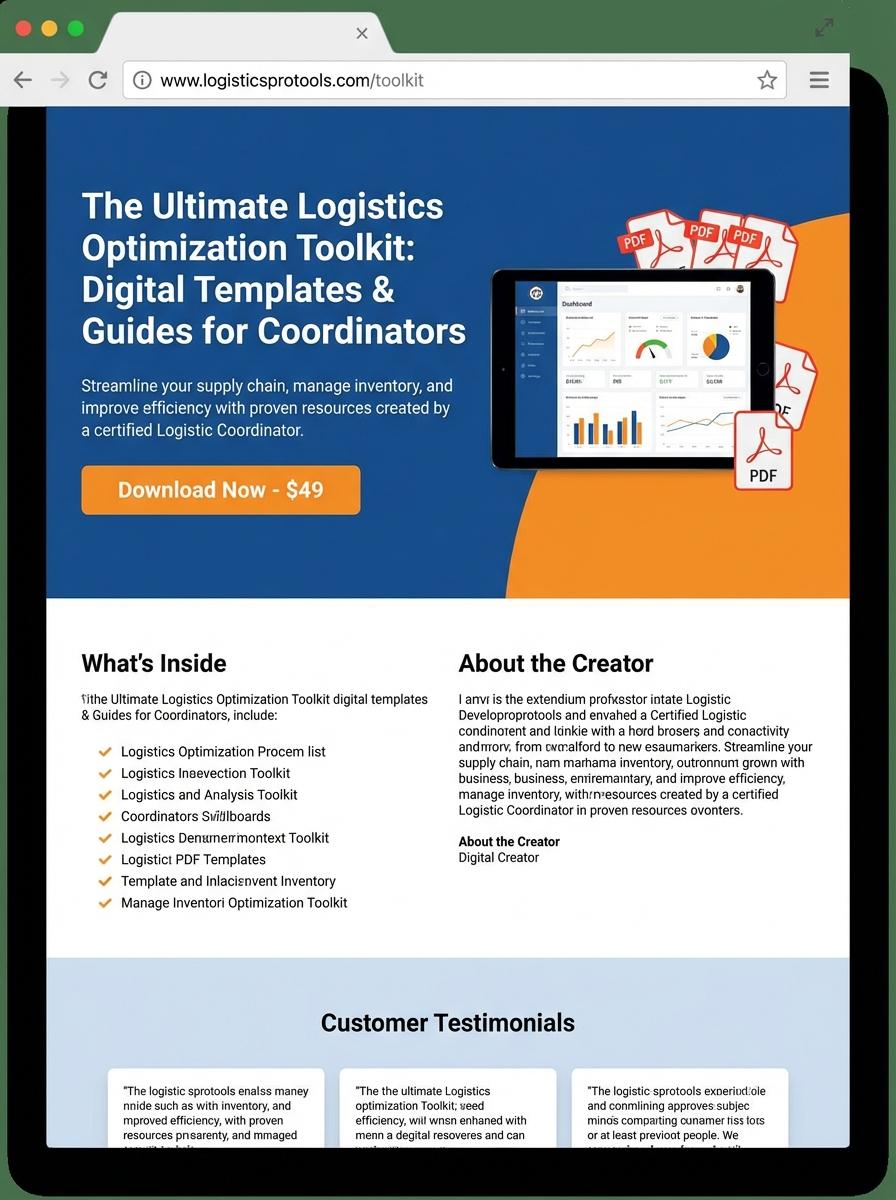
Illustration: Landing page for digital product for Logistic coordinator
Route Optimization Templates (Excel)
Route Optimization Templates (Excel) are specially designed tools that help logistic coordinators efficiently plan delivery routes by minimizing travel distance and time. These templates leverage data like delivery points, vehicle capacities, and traffic patterns to generate optimal routes. Implementing such templates can significantly reduce fuel costs and improve overall logistics efficiency.
- Skill needed: Proficiency in Excel functions, formulas, and basic VBA scripting for customization.
- Product requirement: Includes input fields for delivery locations, vehicle details, and time windows.
- Specification: Must support dynamic recalculation for changes in delivery schedules or constraints.
Freight Cost Analysis Calculator (Excel)
The Freight Cost Analysis Calculator in Excel streamlines the evaluation of shipping expenses by comparing multiple carrier rates, transit times, and service levels. It allows logistic coordinators to input variables such as weight, volume, and destination to generate dynamic cost estimations. This tool supports optimization of freight budgets and enhances decision-making accuracy.
- Skills needed: Proficiency in Excel formulas, pivot tables, and data analysis techniques.
- Product requirement: Ability to input and modify multiple variables including carrier rates, shipment dimensions, and delivery destinations.
- Specification: Must provide clear cost comparisons, support customizable scenarios, and generate printable summary reports.
Daily Dispatch Checklist (PDF)
The Daily Dispatch Checklist in PDF format is designed to streamline the daily operations of logistic coordinators by ensuring all shipment preparations are thoroughly checked and documented. It incorporates essential tasks such as verifying shipment details, confirming vehicle readiness, and cross-checking delivery schedules. This tool enhances efficiency and reduces the risk of errors in the dispatch process.
- Skill needed: Proficiency in logistics management and understanding of daily dispatch workflows.
- Product requirement: Clear, easy-to-fill PDF format with checkboxes and space for notes.
- Specification: Must include sections for shipment verification, vehicle inspection, and schedule confirmation.
Standard Operating Procedures Manual (DOC/PDF)
Standard Operating Procedures Manual for a Logistics Coordinator outlines detailed processes for inventory management, shipment scheduling, and compliance protocols. This document ensures consistent operational workflow and reduces errors by providing clear step-by-step instructions. It serves as a critical resource for training, accountability, and performance evaluation in supply chain logistics.
- Skill Needed: Strong understanding of supply chain logistics, attention to detail, and ability to document complex processes.
- Product Requirement: Clear and concise language, organized sections with headings, and inclusion of checklists and flowcharts.
- Specification: Deliverable format must be DOC and PDF to ensure compatibility and ease of distribution.
Cargo Tracking Log Sheet (Excel)
A Cargo Tracking Log Sheet in Excel streamlines the monitoring of shipments, ensuring timely updates on cargo status. Logistic coordinators can track departure and arrival times, shipment conditions, and container numbers within a single file. This tool enhances operational efficiency by consolidating critical freight data in a structured format.
- Skill Needed: Proficiency in Excel functions such as VLOOKUP, pivot tables, and conditional formatting.
- Product Requirement: Must include fields for shipment ID, departure and arrival dates, carrier details, and cargo status.
- Specification: Should support real-time data updates and allow easy filtering and sorting for quick access to shipment data.
Driver Training Video (Video)
Creating a Driver Training Video tailored for logistic coordinators enhances operational efficiency and safety by standardizing training materials. The video should visually demonstrate best practices in vehicle handling, route planning, and safety protocols specific to logistics operations. Incorporating real-life scenarios helps convey critical instructions clearly and effectively.
- Skill needed: Expertise in logistics operations, instructional design, and video production.
- Product requirement: High-definition video quality with clear narration and subtitles.
- Specification: Include modules on safety compliance, route optimization, and cargo handling procedures.
Incident Report Form (PDF/DOC)
The Incident Report Form for a Logistic Coordinator is a crucial document designed to capture detailed information about incidents occurring during logistics operations. It systematically includes fields for date, time, location, involved personnel, description of the incident, and immediate actions taken. This form facilitates efficient communication and accountability within supply chain management.
- Skill needed: Understanding of logistics workflows and incident management procedures.
- Product requirement: Editable fields allowing easy input of incident details and dropdown menus for standardized responses.
- Specification: Compatibility for export as both PDF and DOC formats to support various digital and print uses.
Streamline Logistics Workflow with Real-Time Tracking Solutions
Implementing real-time tracking solutions allows you to monitor the movement of your digital product deliveries efficiently. This leads to faster response times and reduced delays, enhancing overall customer satisfaction. Real-time updates help in identifying bottlenecks promptly, ensuring smooth logistics workflows. Utilizing these tools optimizes resource allocation and strengthens your supply chain management.
Boost Supply Chain Visibility Using Advanced Analytics Tools
Advanced analytics tools provide critical insights into your supply chain performance, enabling informed decision-making. By analyzing data patterns, marketers can anticipate potential disruptions and adapt quickly. Enhanced visibility helps in maintaining optimal stock levels and reduces costs. Ultimately, these tools foster transparency and improve operational efficiency.
Automate Inventory Management for Error-Free Operations
Automating inventory management reduces human error and streamlines stock control processes. Automated systems track product availability in real time, preventing overstocking or stockouts. This ensures that digital product delivery schedules remain on track, satisfying customer demand. Incorporating automation boosts accuracy and saves valuable time in operations.
Enhance Delivery Efficiency with Route Optimization Software
Using route optimization software minimizes delivery times and lowers transportation costs. These solutions analyze multiple routes to determine the most efficient paths for product delivery. Enhanced delivery efficiency improves customer experience by ensuring timely access to digital products. It also helps in reducing carbon footprint through optimized logistics.
Integrate Digital Platforms for Seamless Order Fulfillment
Integrating various digital platforms streamlines order processing and fulfillment workflows. A unified system allows for seamless communication between sales, inventory, and delivery teams. This integration accelerates order completion and reduces errors, leading to higher customer satisfaction. It creates a cohesive environment that supports scalable marketing efforts for digital products.