
Creating a digital product tailored for Petroleum engineers in the Energy sector involves integrating advanced data analytics, real-time monitoring, and predictive maintenance features. Such a product enhances operational efficiency, reduces downtime, and supports informed decision-making by leveraging domain-specific knowledge and industry standards. Emphasizing user-friendly interfaces ensures seamless adoption among engineers working in complex environments. Explore the article for detailed ideas on developing an effective digital solution for petroleum engineering professionals.
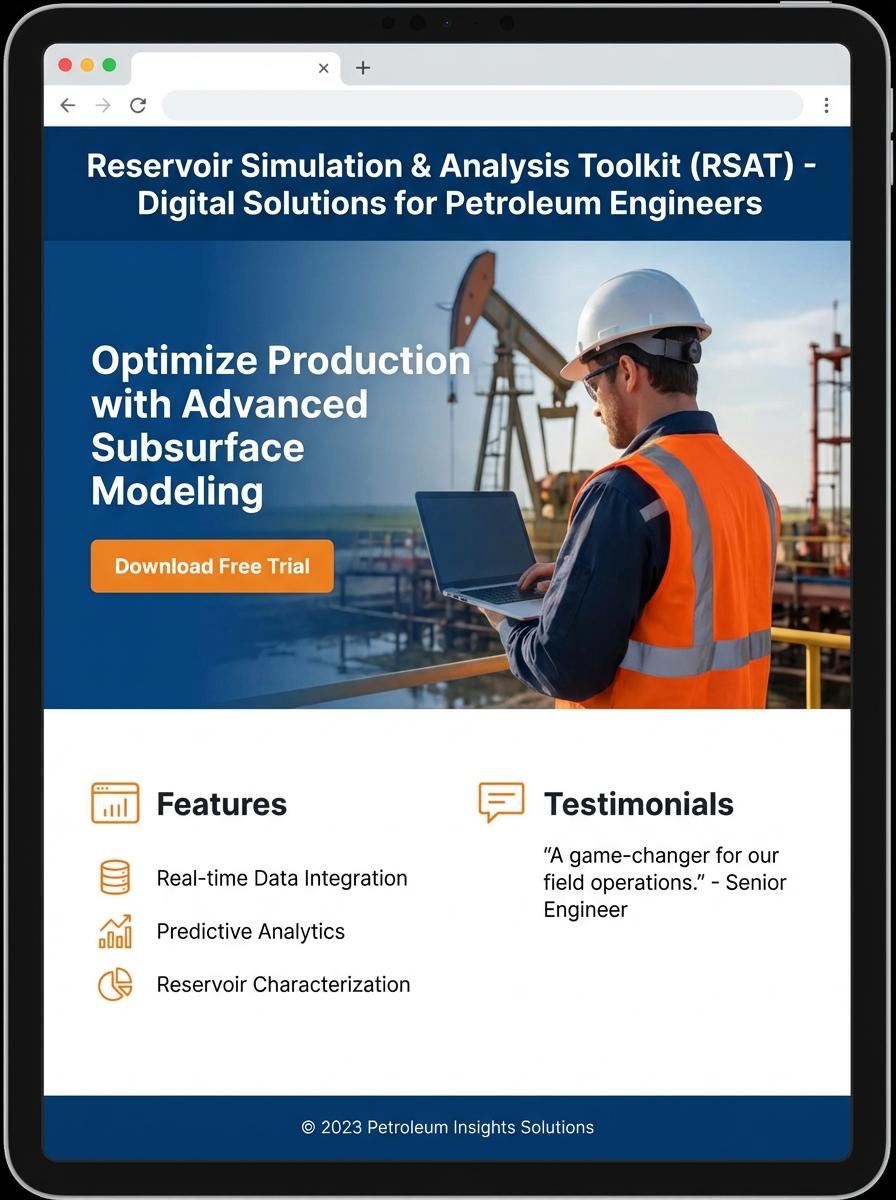
Illustration: Landing page for digital product for Petroleum engineer
Reservoir Simulation Report (PDF)
The Reservoir Simulation Report PDF provides detailed analysis of reservoir performance using dynamic modeling techniques to forecast fluid flow and recovery. It incorporates geological, petrophysical, and production data for accurate simulation outcomes. Visualization of simulation results aids in decision-making for reservoir management and optimization.
- Skill needed: Proficiency in reservoir simulation software such as Eclipse or CMG.
- Product requirement: Clear visualization of simulation outputs including pressure, saturation, and production forecasts.
- Specification: Exportable PDF format with embedded graphs, maps, and detailed interpretative commentary.
Oil Well Production Data Analysis Spreadsheet (Excel)
The Oil Well Production Data Analysis Spreadsheet is designed for petroleum engineers to efficiently compile and analyze production metrics such as daily oil output, gas volumes, and water cuts. This tool enables rapid identification of production trends and anomalies by integrating dynamic charts and formulas tailored for reservoir performance evaluations. Data validation features ensure accuracy, supporting well performance optimization and decision-making processes.
- Skill needed: Proficiency in Excel functions (pivot tables, INDEX-MATCH, and conditional formatting) and knowledge of petroleum production parameters.
- Product requirement: Automated input fields for daily production data and real-time calculation of cumulative oil, gas, and water production volumes.
- Specification: Built-in customizable dashboards with graphical outputs like production decline curves and water cut trends to visualize reservoir behavior.
Enhanced Oil Recovery Workflow Guide (PDF)
The Enhanced Oil Recovery Workflow Guide PDF provides detailed methodologies crucial for petroleum engineers to optimize hydrocarbon extraction. It covers cutting-edge techniques such as chemical flooding, gas injection, and thermal recovery, emphasizing their operational conditions and expected outcomes. This guide supports decision-making with data-driven insights tailored to maximize reservoir performance and economic returns.
- Skill Needed: Proficiency in reservoir engineering and familiarity with fluid dynamics and reservoir simulation software.
- Product Requirement: Comprehensive inclusion of case studies, workflow charts, and technology overviews to ensure practical application.
- Specification: Clear, high-resolution graphics and step-by-step procedural documentation formatted for easy navigation and offline usage.
Pipeline Integrity Assessment Checklist (DOC)
Pipeline integrity assessment is a critical process in the petroleum industry, focusing on identifying potential risks such as corrosion, material flaws, and mechanical damage. The Pipeline Integrity Assessment Checklist serves as a vital digital document guiding engineers through systematic inspection and evaluation procedures. Accurate and comprehensive data collection ensures the pipeline's operational safety and compliance with industry standards.
- Strong knowledge of pipeline materials, corrosion mechanisms, and inspection techniques.
- Digital product must support easy data input, real-time updating, and integration with inspection tools.
- Checklist should include sections for physical inspection, non-destructive testing, and regulatory compliance verification.
Drilling Optimization Calculation Tool (Excel)
Petroleum engineers benefit from a Drilling Optimization Calculation Tool developed in Excel to enhance well planning efficiency. This tool integrates key drilling parameters and real-time data to calculate optimal drilling speed, torque, and hydraulic performance. It supports decision-making by providing actionable insights to minimize drilling costs and non-productive time.
- Skill needed: Proficiency in petroleum engineering concepts and Excel VBA programming.
- Product requirement: Accurate input of drilling parameters such as weight on bit, rotary speed, and mud properties.
- Specification: User-friendly interface allowing real-time updates and automated report generation for drilling performance metrics.
Energy Sector Market Outlook Presentation (PDF)
The Energy Sector Market Outlook Presentation in PDF format provides a detailed analysis of current and projected trends in the petroleum industry. It includes statistical data on production rates, market demands, and regulatory impacts relevant to petroleum engineers. The presentation is tailored to highlight technological advancements and investment opportunities in upstream and downstream sectors.
- Skill needed: Proficiency in petroleum engineering concepts and market analysis techniques.
- Product requirement: Incorporate up-to-date industry data and comprehensive market forecasts.
- Specification: High-quality visual aids, including charts and graphs, must be embedded for clear data representation.
Introduction to Reservoir Engineering Video Tutorial (Video)
Reservoir engineering involves analyzing fluid flow in petroleum reservoirs to optimize hydrocarbon recovery. This video tutorial covers fundamental concepts such as porosity, permeability, and reservoir drive mechanisms. Petroleum engineers gain practical insights into reservoir evaluation and simulation techniques.
- Skill needed: Understanding of fluid mechanics and thermodynamics relevant to reservoir behavior.
- Product requirement: High-quality video with clear visual explanations of complex reservoir models.
- Specification: Includes case studies demonstrating reservoir performance prediction and management strategies.
Streamline Reservoir Analysis with Advanced Digital Tools
Petroleum engineers can greatly improve their workflow by using advanced digital tools for reservoir analysis. These tools enable accurate data processing, helping identify key extraction points more effectively. Enhanced visualization and simulation capabilities reduce uncertainties and speed up decision-making. Embracing these technologies is essential for gaining a competitive edge in the energy industry.
Enhance Drilling Efficiency Using AI-Powered Software
Artificial intelligence (AI) software solutions are revolutionizing drilling operations by optimizing routine tasks and predicting potential issues. Implementing AI-powered software improves drilling speed, safety, and resource allocation. These tools can analyze complex geological data to provide real-time recommendations. Marketers should highlight how AI technology translates into cost savings and higher productivity.
Utilize Real-Time Data Integration for Optimized Production
Integrating real-time data from multiple sources leads to enhanced oil and gas production efficiency. Real-time data integration allows engineers to monitor equipment and reservoir conditions continuously, enabling quick adjustments. This dynamic approach minimizes downtime and improves yield. Marketing strategies should emphasize the benefits of instant data accessibility and its impact on operational success.
Reduce Operational Costs with Predictive Maintenance Technology
Predictive maintenance leverages machine learning and sensor data to foresee equipment failures before they occur. Employing predictive maintenance technology reduces unplanned downtime and lowers repair expenses. This proactive method extends the lifespan of critical machinery and enhances overall operational reliability. Digital product marketers must underline the cost-saving advantages of these innovations.
Boost Decision-Making Accuracy via Cloud-Based Engineering Platforms
Cloud-based engineering platforms provide collaborative environments where teams access and analyze data efficiently. Using cloud technology improves decision accuracy by offering scalable computing power and centralized information. These platforms foster real-time communication and streamline project management. Highlighting cloud solutions can attract users seeking flexibility and improved workflow integration.